Paul Gilroy
The Black Atlantic and Double Consciousness
“The time has come for the primal history of modernity to be reconstructed from the slaves’ points of view.” (p. 55)
“It is the struggle to have blacks perceived as agents, as people with cognitive capacities and even with an intellectual history - attributes denied by modern racism - that is for me the primary reason for writing this book.” (p. 6)
Preface
The work begins with Gilroy’s attempt to situate Black thinkers in relation to the Enlightenment, acknowledging the influence of the philosophical and intellectual movement on their ideas, but also the unique position of Black thinkers within the modern paradigm.
“The Black Atlantic developed from my uneven attempts to show these students that the experiences of black people were part of the abstract modernity they found so puzzling and to produce as evidence some of the things that black intellectuals had said - sometimes as defenders of the West, sometimes as its sharpest critics - about their sense of embeddedness in the modern world.” (p. ix)
Gilroy cautions readers against interpreting his work through the lens of “racial purity,” particularly because the text is essentially an essay on inescapable hybridity and the blending of ideas. Moreover, he challenges the limitation of identities, which The Black Atlantic demonstrates as perpetually unfinished and constantly being re-created.
The preface to the Brazilian edition of the work, however, highlights one of the main criticisms that can be made of Gilroy’s book. The original edition of The Black Atlantic was heavily criticized for completely ignoring Brazil, Latin America, and essentially the entire diaspora beyond the U.S., England, and, at most, the Caribbean.
In response to these criticisms, Gilroy writes a self-critical preface for the Brazilian edition of the book. In this self-criticism, one of the most relevant points to observe is that, in some ways, one of the central discussions of the work is, according to the author himself, irrelevant to the Brazilian context. Gilroy points out that his critique of racial essentialism does not make sense in a country where Black Movements are still fighting to recognize themselves and be recognized as Black. In a country that denies Blackness and forcefully promotes discourses of mestizaje and racial democracy, questioning essentialism may not be a productive endeavor.
Nonetheless, the critique of adopting a one-size-fits-all model of Africanness or Blackness, shaped by the U.S. and, according to Gilroy, misaligned with the reality of a globalized society, remains relevant.
The Black Atlantic as a Counterculture of Modernity
The chapter aims to introduce some controversial arguments that will be explored in greater detail later in the book. It begins by demonstrating how nationalist paradigms fall short when confronted with the intercultural and transnational formation of the Black Atlantic.
The text opens with the observation that the merging of Black and European identities necessitates specific forms of double consciousness. Being both Black and European simultaneously constitutes an act of political insubordination against the racist and nationalist discourses of ethnic absolutism. However, it is also a source of constant tension, stemming from the effort to navigate two distinct perspectives at once.
The characterization of identities—often perceived as mutually exclusive—based on skin colors and tones is an essential feature of modernity.
“Though largely ignored by recent debates over modernity and its discontents, these ideas about nationality, ethnicity, authenticity, and cultural integrity are characteristically modern phenomena that have profound implications for cultural criticism and cultural history.” (p. 2)
However:
“Any shift towards a postmodern condition should not, however, mean that the conspicuous power of these modern subjectivities and the movements they articulated has been left behind. Their power has, if anything, grown, and their ubiquity as a means to make political sense of the world is currently unparalleled by the languages of class and socialism by which they once appeared to have been surpassed.” (p. 2)
In contrast to the ideas of cultural nationalism, which the author sees reproduced across the political spectrum, Gilroy reflects on the “mestizaje” and hybridity of cultures. After all, notions of nationality, ethnicity, and cultural integrity are modern subjectivities shaped by racism and colonialism.
Gilroy then introduces ships—living systems, mobile micro-cultural and micro-political entities—as representations of movement, departure and return, and the export and import of ideas and artifacts. These serve as the central axis of his conceptualization of identity:
“I have settled on the image of ships in motion across the spaces between Europe, America, Africa, and the Caribbean as a central organising symbol for this enterprise and as my starting point.” (p. 4)
For Gilroy, The Black Atlantic represents a transcultural and international formation, characterized by a rhizomatic and fractal structure.
→ Cultural Studies in Black and White
Gilroy highlights the glaring issues within so-called “cultural studies,” particularly their ties to nationalism and ethnocentrism. The very question of “whose culture?” often determines the focus and scope of cultural studies.
According to Gilroy, there is a tension between rejecting cultural studies that racialize the “other” as an object of knowledge, power, and cultural critique, and recognizing the importance of taking Black cultural expressions seriously within academia.
“It is significant that prior to the consolidation of scientific racism in the nineteenth century the term “race” was used very much in the way that the word “culture” is used today. (…) As far as the future of cultural studies is concerned, it should be equally important that both were centrally employed in those European attempts to think through beauty, taste, and aesthetic judgement that are the precursors of contemporary cultural criticism.” (p. 8)
Gilroy proposes transcending national and nationalist perspectives in the analysis of Black culture:
“Getting beyond these national and nationalistic perspectives has become essential for two additional reasons. The first arises from the urgent obligation to reevaluate the significance of the modern nation state as a political, economic, and cultural unit. (…) The second reason relates to the tragic popularity of ideas about the integrity and purity of cultures. In particular, it concerns the relationship between nationality and ethnicity.” (p. 7)
The author begins to highlight the importance of the Atlantic, navigation, and the exchange of radical ideas and experiences among Black sailors and travelers moving between the New and Old Worlds in shaping intellectual identities.
“the Morant Bay Rebellion in Jamaica in 1865 (…) is doubly significant because it represents an instance of metropolitan, internal conflict that emanates directly from an external colonial experience. These crises in imperial power demonstrate their continuity. It is part of my argument that this inside/outside relationship should be recognised as a more powerful, more complex, and more contested element in the historical, social, and cultural memory of our glorious nation than has previously been supposed.” (p. 11)
In this system, the ship assumes a central position:
Linebaugh: “the ship remained perhaps the most important conduit of Pan-African communication before the appearance of the long-playing record.” (p. 13)
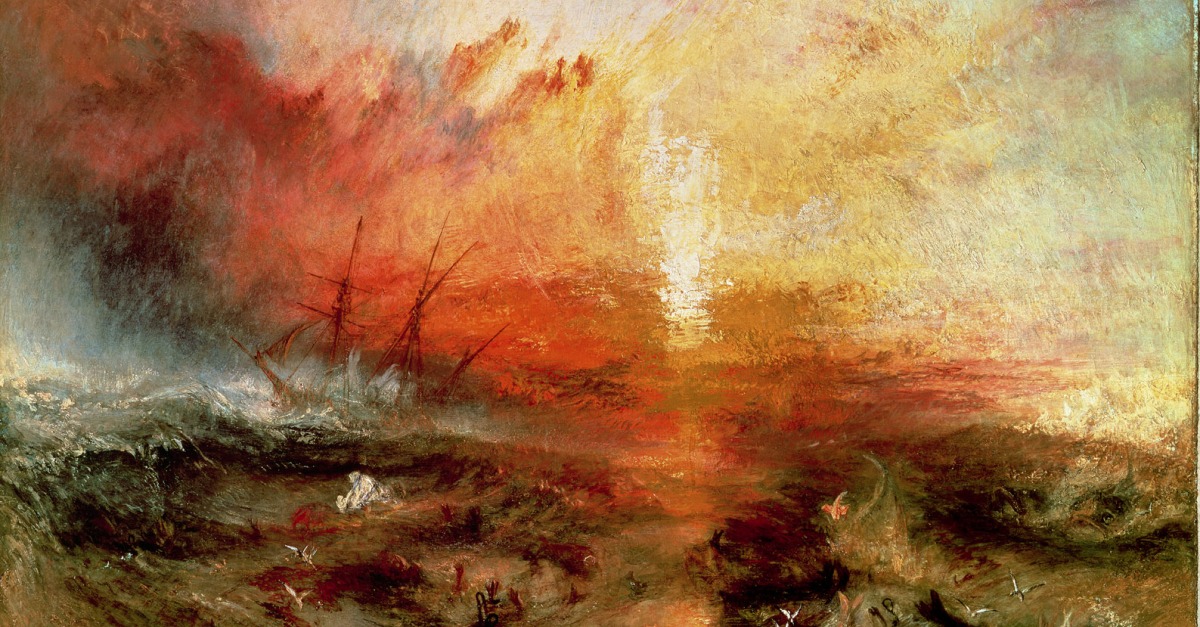
“Turner’s extraordinary painting of the slave ship remains a useful image not only for its self-conscious moral power and the striking way that it aims directly for the sublime in its invocation of racial terror, commerce, and England’s ethico-political degeneration. It should be emphasised that ships were the living means by which the points within that Atlantic world were joined. They were mobile elements that stood for the shifting spaces in between the fixed places that they connected (…) They were something more - a means to conduct political dissent and possibly a distinct mode of cultural production.” (p. 16-17)
O Slave Ship como paradigma de análise dos aparatos de vigilância
“In opposition to both of these nationalist or ethnically absolute approaches, I want to develop the suggestion that cultural historians could take the Atlantic as one single, complex unit of analysis in their discussions of the modern world and use it to produce an explicitly transnational and intercultural perspective.” (p. 15)
Gilroy references several Black authors and historical figures who, originating from different countries, found their contact with foreign cultures to be a formative element of their perspectives, which later shaped modern Black thought. The most extensively discussed example is the life of Martin Delany.
“The specificity of the modern political and cultural formation I want to call the black Atlantic can be defined, on one level, through this desire to transcend both the structures of the nation state and the constraints of ethnicity and national particularity.” (p. 19)
Gilroy recounts how Delany’s journey to Africa brought sobering realizations that a spiritual connection to the land would not automatically or consistently forge a bond among all members of the Black diaspora. The Enlightenment notion of “civilization” had, to some extent, already permeated Delany’s vision, including his utopias and future plans for the Black population in the United States. As Gilroy states, a simple return to Africa would not suffice.
In Delany’s work Blake, Gilroy sees Blackness as more of a political issue than a matter of shared cultural condition (p. 27).
→ Black Politics and Modernity
This section of the book explores the nuances surrounding the possibility of nationalism serving as a source and form of Black resistance.
“The recent history of blacks, as people in but not necessarily of the modern, western world, a history which involves processes of political organisation that are explicitly transnational and international in nature, demands that this question is considered very carefully.” (p. 29)
“Are the inescapable pluralities involved in the movements of black peoples, in Africa and in exile, ever to be synchronised?” (p. 30)
Still using Delany as an example, Gilroy presents two views that, for him, represent two facets of essentialism:
“They can be loosely identified as the essentialist and the pluralist standpoints though they are in fact two different varieties of essentialism: one ontological, the other strategic.” (p. 31)
About the ontological essentialist view:
“The ontological essentialist view has often been characterised by a brute pan-Africanism. It has proved unable to specifY precisely where the highly prized but doggedly evasive essence of black artistic and political sensibility is currently located, but that is no obstacle to its popular circulation. ” (p. 31)
And about the pluralistic position
“This perspective currently confronts a pluralistic position which affirms blackness as an open signifier and seeks to celebrate complex representations of a black particularity that is internally divided: by class, sexuality, gender, age, ethnicity, economics, and political consciousness. The difficulty with this second tendency is that in leaving racial essentialism behind by viewing “race” itself as a social and cultural construction, it has been insufficiently alive to the lingering power of specifically racialised forms of power and subordination. ” (p. 32)
“No less than their predecessor Martin Delany, today’s black intellectuals have persistently succumbed to the lure of those romantic conceptions of “race,” “people,” and “nation” which place themselves, rather than the people they supposedly represent, in charge of the strategies for nation building, state formation, and racial uplift” (p. 34)
Essentialism and pluralism are presented as distinct but symbiotic perspectives. For Gilroy, both are varieties of essentialism—one ontological and the other strategic. The ontological view is characterized by a crude Pan-Africanism, where there is a disconnect between “the intellectual” and “the masses,” with the intellectual’s task being to present racial consciousness to the masses. On the other hand, the pluralist position sees Blackness as an open signifier, acknowledging that Black identity can be internally divided by class, sexuality, gender, etc. There is no unified notion of the Black community.
The notion of Black people as a national or proto-national group with its own isolated culture serves a mystifying function, which, according to the author, prevents and censors any discussions about the inconsistencies and contradictions within Africological discourse.
To conclude the chapter, the author asserts that Black musical expression was responsible for reproducing what Bauman refers to as a counterculture of modernity.
“The vitality and complexity of this musical culture offers a means to get beyond the related oppositions between essentialists and pseudo-pluralists on the one hand and between totalising conceptions of tradition, modernity, and post-modernity on the other.” (p. 36)
Gilroy summarizes the philosophical dynamics of this counterculture in two key points: its normative character and its utopian aspirations.
The normative character involves the demand for the fulfillment of unkept promises in society. Through the expression of societal incongruities and hypocrisies, the art of this counterculture highlights the flaws of society, such as racialized injustice, among others. For Gilroy, this aligns with the politics of fulfillment.
The question of utopias, however, is more complex. In what are called politics of transfiguration, Black counterculture expresses new desires, new social relations, and new ways of associating with racial interpretation and resistance, both within groups and against oppressors. These politics of transfiguration allow for imagining an anti-modern past and a post-modern future.
“The politics of transfiguration therefore reveals the hidden internal fissures in the concept of modernity.” (p. 38)
Regarding the Marxist position on interpreting the situation of the society in which Black counterculture arises:
“However, where lived crisis and systemic crisis come together, Marxism allocates priority to the latter while the memory of slavery insists on the priority of the former.” (p. 40)
Masters, Mistresses, Slaves, and the Antinomies of Modernity
The second chapter of the work mainly addresses how theoretical concepts of modernity glaringly ignore the issue of “race.” For the author, racial slavery was essential to Western civilization and to the very formation of modernity.
The discussion begins with theories contemporary to Gilroy on postmodernity, such as those presented by Habermas and Lyotard, among others. Gilroy points out that some of these theorists returned to modernity as a way to identify and delineate what would be new or original in the so-called postmodernity. Others, like Lyotard, analyze the postmodern as a simple replacement of the modern, without delving into the historical moments that separate modernity from postmodernity or the relationship between the two and the processes of modernization.
“Defenders and critics of modernity seem to be equally unconcerned that the history and expressive culture of the African diaspora, the practice of racial slavery, or the narratives of European imperial conquest may require all simple periodisations of the modern and the postmodern to be drastically rethought.” (p. 42)
Analyzing postmodernity as what Habermas calls the “continuation of the Enlightenment project,” Gilroy questions whether the so-called crisis of modernity and modern values might actually be a crisis of intellectuals whose consciousness was previously grounded in these values.
“It can be argued that much of the supposed novelty of the post-modern evaporates when it is viewed in the unforgiving historical light of the brutal encounters between Europeans and those they conquered, slaughtered, and enslaved. The periodisation of the modern and the postmodern is thus of the most profound importance for the history of blacks in the West and for chronicling the shifting relations of domination and subordination between Europeans and the rest of the world. It is essential for our understanding of the category of “race” itself and of the genesis and development of successive forms of racist ideology. It is relevant, above all, in elaborating an interpretation of the origins and evolution of black politics. A concept of modernity that is worth its salt ought, for example, to have something ‘to contribute to an analysis of how the particular varieties of radicalism articulated through the revolts of enslaved people made selective use of the ideologies of the western Age of Revolution and then flowed into social movements of an anti-colonial and decidedly anti-capitalist type. Lastly, the overcoming of scientific racism (one of modernity’s more durable intellectual products) and its post-war transmutation into newer, cultural forms that stress complex difference rather than simple biological hierarchy may provide a telling, concrete example of what scepticism towards the grand narratives of scientific reason adds up to.” (p. 43)
For Gilroy, the analysis of modernity should not only include Black intellectuals who have been relegated to obscurity or intentionally omitted, but also invert the relationship between margin and center found within discourses of racial supremacy. To achieve this, it is necessary to rethink the modern relationship between master and slave.
→ Slavery and the Enlightenment Project
“I propose that the history of the African diaspora and a reassessment of the relationship between modernity and slavery may require a more complete revision of the terms in which the modernity debates have been constructed than any of its academic participants may be willing to concede.” (p. 46)
n contrast to Berman, Gilroy argues that modernity cannot be seen as a uniform movement that affected everyone, but rather as experiences full of variation and discontinuity, with an inescapable plurality of subjectivities and identities.
Gilroy demonstrates how Berman, in his work, links the cultural forms of the Black Atlantic to the image of the Western working class, due to his inability to give proper weight to the plurality that, for Gilroy, is integral to modernity and contradicts Berman’s proposal of a totalizing modern identity. There are multiple possible identities, and the differences between “Black identity” and the homogeneous modern identity are not defined by the exclusion of Black people from the modern framework. After all, the cultural expressions of Black identity emerge from the plantations and sugar mills, institutions that are distinctly modern.
“The key to comprehending this lies not in the overhasty separation of the cultural forms particular to both groups into some ethnic typology but in a detailed and comprehensive grasp of their complex interpenetration. The intellectual and cultural achievements of the black Atlantic populations exist partly inside and not always against the grand narrative of Enlightenment and its operational principles” (p. 48)
Gilroys definition of modernity:
“Modernity is understood as a distinct configuration with its own spatial and temporal characteristics defined above all through the consciousness of novelty that surrounds the emergence of civil society, the modern state, and industrial capitalism.” (p. 49)
The author comments on the erasure of issues and themes related to colonialism and slavery as foundational elements of modernity, inseparable even from the lives and works of Enlightenment philosophers and major historical figures. This erasure, as well as the hypocrisy of Enlightenment authors in addressing the colonies and enslaved people, is deeply explored in [[ Susan Buck-Morss ]].
This erasure causes, from this perspective, slavery to be seen as part of the history of Black people, rather than as part of the history of Europe:
“In this setting, it is hardly surprising that if it is perceived to be relevant at all, the history of slavery is somehow assigned to blacks. It becomes our special property rather than a part of the ethical and intellectual heritage of the West as a whole. This is only just preferable to the conventional alternative response which views plantation slavery as a premodern residue that disappears once it is revealed to be fundamentally incompatible with enlightened rationality and capitalist industrial production.” (p. 49)
Gilroy identifies two significant points to be analyzed in Hegel’s Phenomenology of Spirit. First, he argues that the beginning of the work directly points to the intimate association between modernity and slavery. The second relevant point concerns the conflicts and forms of dependency inherent in the master-slave relationship, as explored by Hegel, which pave the way for addressing the modern brutalism and terror that are commonly ignored.
“Taken together, these problems offer an opportunity to transcend the unproductive debate between a Eurocentric rationalism which banishes the slave experience from its accounts of modernity while arguing that the crises of modernity can be resolved from within, and an equally occidental anti-humanism which locates the origins of modernity’s current crises in the shortcomings of the Enlightenment project” (p. 54)
The creative force of the populations of the Black Atlantic offers a way out of this situation:
“The way these populations continue to make creative, communicative use of the memory of slavery points constructively away from the twin positions that have overdetermined the debate on modernity so far - an uncritical and complacent rationalism and a self-conscious and rhetorical anti-humanism which simply trivialises the potency of the negative.” (p. 55)
About slavery and the Plantation economic system:
“Plantation slavery was more than just a system of labour and a distinct mode of racial domination. Whether it encapsulates the inner essence of capitalism or was a vestigial, essentially precapitalist element in a dependant relationship to capitalism proper, it provided the foundations for a distinctive network of economic, social, and political relation” (p. 54-55)
“The slaves’ perspectives require a discrete view not just of the dynamics of power and domination in plantation societies dedicated to the pursuit of commercial profit but of such central categories of the Enlightenment project as the idea of universality, the fixity of meaning, the coherence of the subject, and, of course, the foundational ethnocentrism in which these have all tended to be anchored.” (p. 55)
“They provocatively suggest that many of the advances of modernity are in fact insubstantial or pseudo-advances contingent on the power of the racially dominant grouping and that, as a result, the critique of modernity cannot be satisfactorily completed from within its own philosophical and political norms, that is, immanently.” (p. 56)
“Racial terror is not merely compatible with occidental rationality but cheerfully complicit with it.” (p. 56)
“We must remember that however modern they may appear to be, the artistic practices of the slaves and their descendants are also grounded outside modernity. (…) This artistic practice is therefore inescapably both inside and outside the dubious protection modernity offers.” (p. 57)
→ Lord and bondsman in a Black Idiom
Gilroy discusses the life and autobiographies of Frederick Douglass, asserting that his relationship with modernity was complex and mutable.
Regarding Douglass’s trip to Egypt, Gilroy highlights the power of Egyptian civilization over the diasporic imagination:
“Egypt also provided the symbolic means to locate the diaspora’s critique of Enlightenment universals outside the philosophical repertoire of the West.” (p. 60)
Regarding Hegel, Gilroy asserts that Douglass inverted Hegel’s metanarrative of power into a metanarrative of emancipation.
“Douglass can be read as if he is systematically reworking the encounter between master and slave in a striking manner which inverts Hegel’s own allegorical scheme. It is the slave rather than the master who emerges from Douglass’s account possessed of “consciousness that exists for itself,” while his master becomes the representative of a “consciousness that is repressed within itself.”” (p. 60)
“In Hegel’s allegory, which correctly places slavery at the natal core of modern sociality, we see that one solipsistic combatant in the elemental struggle prefers his conqueror’s version of reality to death and submits. He becomes the slave while the other achieves mastery. Douglass’s version is quite different. For him, the slave actively prefers the possibility of death to the continuing condition of inhumanity on which plantation slavery depends.” (p. 63)
About violence and struggle:
“Douglass’s departure from the pacifism that had marked his early work is directly relevant to his critical understanding of modernity. It underscored the complicity of civilisation and brutality while emphasising that the order of authority on which the slave plantation relied cannot be undone Without recourse to the counter-violence of the oppressed.” (p. 63)
From the accounts of Douglass’s life and other escaped slaves, including the tragic case of an enslaved mother who, cornered by her master’s overseers after a failed escape, kills her own daughter, Gilroy demonstrates how the reality of slaves contradicts Hegel’s thesis that they would prefer submission to death. This serves to conclude the inversion of Hegelian theory based on the lived experience of Frederick Douglass.
Jewels Brought from Bondage: Black Music and the Politics of Authenticity
This chapter presents the concepts discussed in the work through examples and analysis of Black music. From this connection, the chapter attempts to demonstrate why a polarization between “essentialist” and “non-essentialist” views on race is no longer useful, proposing the use of anti-anti-essentialist concepts.
“Through a discussion of music and its attendant social relations, I want to clarify some of the distinctive attributes of black cultural forms which are both modern and modernist. They are modern because they have been marked by their hybrid, creole origins in the West, because they have struggled to escape their status as commodities and the position within the cultural industries it specifies, and because they are produced by artists whose understanding of their own position relative to the racial group and of the role of art in mediating individual creativity with social dynamics is shaped by a sense of artistic practice as an autonomous domain either reluctantly or happily divorced from the everyday lifeworld.” (p. 73)
These musical works have a special power that derives from a duality, from their uncertain location, simultaneously inside and outside the conventions and aesthetic rules of modernity.
Gilroy criticizes the modern notion that the political achievements of the bourgeoisie take precedence over ideology and cultural discourses, also criticizing the emphasis this view places on textuality.
The author states that working with contemporary forms of Black expressive culture involves a particular problem, which is the issue of what analytical status should be given to the variation present among Black communities and Black cultures, revealed through their cultural and musical practices.
This issue leads us directly to the question of the essentialism of Black being and again to the problem of nationalism in the formation of Black identities.
“With a few noble exceptions, critical accounts of the dynamics of black subordination and resistance have been doggedly monocultural, national, and ethnocentric. This impoverishes modern black cultural history because the transnational structures which brought the black Atlantic world into being have themselves developed and now articulate its myriad forms into a system of global communications constituted by flows. ” (p. 80)
Gilroy presents the proliferation of a new analytical orthodoxy that, in the name of anti-essentialism and theoretical rigor, argues that since Black particularity is socially and historically constructed and plurality is inescapable, there is no reason or space for attempting to identify any unifying dynamics, structure, or sentiment in contemporary Black culture.
Periferia é periferia em todo lugar.
Agreeing that the consideration of similarities and differences between Black cultures remains an urgent need, Gilroy asserts that the aforementioned analytical orthodoxy is premature in its rejection of the problem of theorizing Black identity.
→ UK Blak
Black communities in the United Kingdom, due to their history of being predominantly formed after World War II, tend to have more in common in terms of immigration than slavery. For this reason, it is possible to identify subcultures within these communities that result from direct influences from the Caribbean and Black America.
“In dealing with the relationship of race to class it has been commonplace to recall Stuart Hall’s suggestive remark that the former is the modality in which the latter is lived.” (p. 85)
“What is more significant for present purposes is that in the Africentric discourse on which both sides of opinion draw the idea of a diaspora composed of communities that are both similar and different tends to disappear somewhere between the invocations of an African motherland and the powerful critical commentaries on the immediate, local conditions in which a particular performance of a piece of music originates.” (p. 87)
→ Music Criticism and the Politics od Racial Authenticity
“My point here is that the unashamedly hybrid character of these black Atlantic cultures continually confounds any simplistic (essentialist or anti-essentialist) understanding of the relationship between racial identity and racial non-identity, between folk cultural authenticity and pop cultural betrayal.” (p. 99)
→ Soul Music and the Making of Anti-Anti-Essentialism
“The syncretic complexity of black expressive cultures alone supplies powerful reasons for resisting the idea that an untouched, pristine Africanity resides inside these forms, working a powerful magic of alterity in order to trigger repeatedly the perception of absolute identity.” (p. 101)
“Comprehend the reproduction of cultural traditions not in the unproblematic transmission of a fixed essence through time but in the breaks and interruptions which suggest that the invocation of tradition may itself be a distinct, though covert, response to the destabilising flux of the post-contemporary world” (p. 101)
“Black identity is not simply a social and political category to be used or abandoned according to the extent to which the rhetoric that supports and legitimises it is persuasive or institutionally powerful.” (p. 102)
“They point towards an anti-anti-essentialism that sees racialized subjectivity as the product of the social practices that supposedly derive from it: “Rather than seeing the modern soul as the reactivated remnants of an ideology, one would see it as the present correlative of a certain technology of power over the body. It would be wrong to say that the soul is an illusion, or an ideological effect. On the contrary it exists, it has a reality, it is produced permanently around, on, within the body by the functioning of power that is exercised.”” (p. 102)